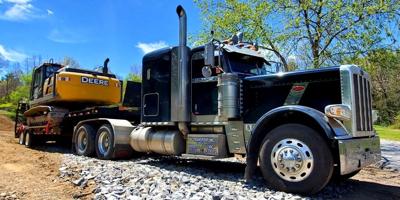


WASHINGTON – A West Virginia trucking company has asked the U.S. Supreme Court to decide whether federal mine safety regulators can oversee its off-site truck repair shop, renewing a legal fight over how far the government’s authority extends beyond mining sites.
In its November 5 petition, KC Transport is seeking review of a divided federal appeals court ruling that classified its maintenance facility in Emmett as a mine under federal law. The company argues a shop where no minerals are extracted, milled or prepared falls outside the government’s mine safety jurisdiction.
The petition brings the dispute back to the Supreme Court after the justices ordered a lower court to reconsider the case following their 2024 decision eliminating a longstanding requirement that judges defer to reasonable agency interpretations of ambiguous laws.
Thursday’s filing asks the justices to take the case; it does not represent an argument session or a ruling on the merits.
The dispute began March 11, 2019, when a Mine Safety and Health Administration inspector visited KC Transport’s maintenance yard after inspecting a nearby coal preparation plant. The inspector found two raised trucks undergoing repairs without being blocked against movement. A worker was underneath one of the trucks, according to the appeals court’s account.
The inspector issued two citations carrying proposed civil penalties totaling $8,251. The parties agreed that if the Mine Act applied to the facility, the citations should stand and the company would owe the penalties.
KC Transport challenged the agency’s authority to issue the citations. An administrative law judge upheld them, but the Federal Mine Safety and Health Review Commission reversed, concluding that the independent repair facility was not a mine. The labor secretary then sought review in the U.S. Court of Appeals for the District of Columbia Circuit.
The legal question turns on Congress’ definition of a mine in the Federal Mine Safety and Health Act of 1977. The law covers not only mineral extraction sites and associated roads, but also facilities, equipment and other property “used in” extracting minerals, milling them or preparing coal.
Federal officials argued that KC Transport’s facility and trucks fell within that definition because they were used in mining activity. The appeals court ruled 2-1 on April 17 that the facility qualified as a mine even though it was not located at an extraction site.
The majority concluded that the statute reaches a facility “necessarily connected with the use and operation of extracting, milling, or processing coal and other minerals.” It said its conclusion rested on an independent reading of the law, without deference to the agency.
The court’s account described substantial connections between the maintenance yard and nearby mining operations. About 60% of the facility’s services supported five mines operated by Ramaco Resources. The two cited trucks regularly hauled coal from those mines to a preparation plant about a mile from the repair facility and were not licensed for public-road use.
KC Transport, represented by Pacific Legal Foundation, argues that the appeals court’s interpretation stretches the statute beyond its proper limits and conflicts with decisions from the 6th U.S. Circuit Court of Appeals and other federal courts.
“Under any fair reading of the Mine Act, a repair shop where no one extracts, mills, or prepares coal or other minerals is not a mine, and the government can’t regulate it as one,” foundation attorney Adi Dynar said.
The company contends the ruling could expose other independent businesses serving the mining industry, including repair shops and suppliers, to mine safety regulation. The appeals court, however, based its decision on the maintenance facility’s connection to mining operations, rather than holding that every business serving a mine falls under the law.
KC Transport first sought Supreme Court review in 2024. After deciding Loper Bright Enterprises v. Raimondo, which overturned the doctrine known as Chevron deference, the justices set aside the appeals court’s earlier judgment and returned the case for further consideration.
The same divided panel again ruled against the company in April, and the full appeals court declined to rehear the case in July. KC Transport is now asking the justices to settle the reach of the Mine Act themselves.