


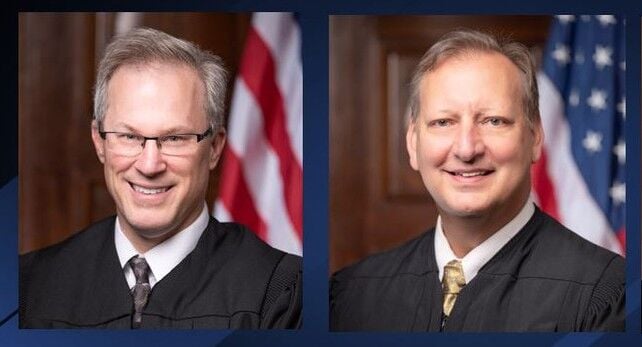
Intermediate Court of Appeals Judges Dan Greear (left) and Charles Lorensen
CHARLESTON – Two of the three judges on West Virginia’s Intermediate Court of Appeals are asking to step back from litigation over a Tucker County data center project after environmental groups raised concerns over conflicts of interest.
The cases center on a proposed Ridgeline data center backed by Fundamental Data and a contested air permit that environmentalists say state regulators have partly shielded from public view.
One of the appeals is brought by environmental groups Tucker United, Friends of Blackwater and the West Virginia Highlands Conservancy challenging how the state Department of Environmental Protection and the Air Quality Board handled claims of confidential business information in Fundamental Data’s air permit.
ICA Judge Charles Lorensen was the first to exit the litigation.
In March, the ICA notified parties in the Fundamental Data case that Lorensen “will not participate in any deliberations or decisions” in that case because his son William is one of the Bowles Rice attorneys representing Fundamental Data.
The environmental groups now are pressing to extend Lorensen’s recusal into their case. Although Fundamental Data is not formally listed as a party in that appeal, the groups argue in a motion that the company is “the company at the center of this appeal” because it is the Ridgeline permit applicant and now permit holder. They also say Fundamental Data’s confidential business information is effectively at stake.
If state regulators prevail in the environmental case, the environmental groups say the “true beneficiary” will be Fundamental Data, which would see its business plan and air emissions shielded from fuller public scrutiny. If the groups prevail, they say, Fundamental Data will likely face “significant setback and additional costs” in its pursuit of the Ridgeline project.
The environmental groups characterize Fundamental Data’s interest in their case as “obvious, undeniable and inseverable” and say the same concerns that forced Lorensen off of the Fundamental case apply just as strongly to their case.

Hanshaw
The situation surrounding ICA Chief Judge Dan Greear has drawn more public attention because it involves not only family ties but also campaign support from House Speaker Roger Hanshaw, a partner at Bowles Rice and counsel to Fundamental Data.
In a March 18 disclosure in the Fundamental case, the ICA said Greear’s son had worked as a summer associate at Bowles Rice in 2024 and 2025 and is slated to join the firm’s Morgantown office in this fall. The notice also said Fundamental Data is represented by Hanshaw who was House Speaker when Greear was chief counsel to the House of Delegates.
While he said there was no basis for his disqualification, Greear invited any party with concerns to file a formal disqualification motion “out of an abundance of caution.”
The environmental groups didn’t do so at first, but that changed after news coverage about Hanshaw’s ties to Greear, which also includes Hanshaw co‑hosting and sponsoring multiple fundraisers. The West Virginia Democratic Party then issued a press release asking Greear to recuse from the data center litigation because of those fundraising ties and the scale of the contributions.
On April 20, Greear wrote to West Virginia Supreme Court Chief Justice Haley Bunn asking for approval of his voluntary recusal from the Fundamental Data case, citing his relationship with Hanshaw, the campaign fundraising events, his son’s employment with Bowles Rice and the fact that one of his law clerks, Laura Lorenson, is married to Fundamental Data attorney William Lorenson.
Greear said he was confident he could fairly serve as a judge, but cited the media attention and wanting to ensure timely consideration of the case as the reason for his request.
The environmental groups responded by formally supporting Greear’s withdrawal in the Fundamental case. On April 30, they filed the motion to disqualify Lorensen and Greear from their case as well.
Greear followed with an April 30 letter to Bunn again saying he was requesting a voluntary recusal in that case as well, agreeing that if he was recused from the Fundamental Data case, he should be removed from the environmental appeal as well. Lorensen sent a similar letter to Bunn on May 1.
West Virginia Intermediate Court of Appeals case numbers 26-ICA-92 (Fundamental Data) and 25-ICA-391 (Environmental case)


