

West Virginia Auditor Mark Hunt
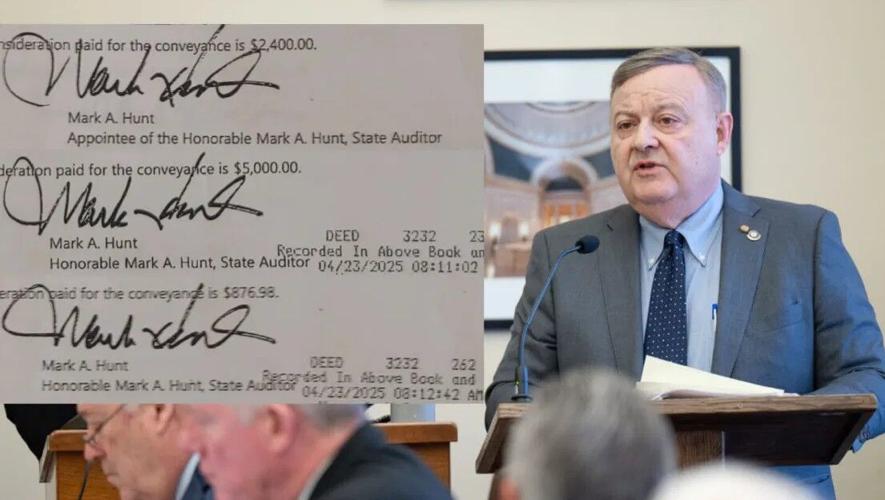
CHARLESTON – A Republican state delegate is calling for West Virginia Auditor Mark Hunt to resign over nine tax deeds benefiting a company connected to a longtime friend, rejecting Hunt’s explanation he signed the documents to correct office mistakes and avoid litigation.
On November 9, Delegate Tristan Leavitt (R-Kanawha) said on MetroNews’ “Talkline” the central question was not simply whether Hunt could sign documents assigned by law to a deputy commissioner, but whether the office could issue the deeds after a statutory deadline without a court order.
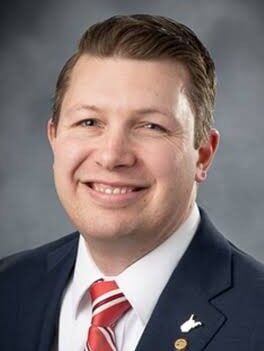
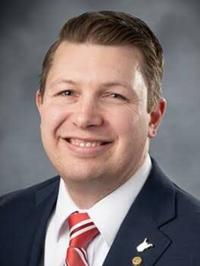
Leavitt
“The fact that Mark Hunt signed them, I think, is less significant than the fact that no one should have signed them at all,” Leavitt said, arguing the transactions violated state law.
Hunt, appearing earlier on the same program, defended his authority to sign the deeds and denied giving preferential treatment to his friend, Charleston bankruptcy attorney Robert L. Johns.
Asked Monday why he personally intervened in these nine transactions, Hunt said they were the only deeds brought to his attention involving that specific problem.
“I would have done it for anyone who had the same problem,” Hunt, a Republican, said. “The auditor certainly has discretion to correct mistakes.”
The interviews followed a West Virginia Watch investigation published November 8 found Hunt signed nine deeds between March and June 2025 transferring properties in Kanawha and Boone counties to MAPA LLC, a company incorporated under Patricia Johns, Robert Johns’ wife. The outlet reported that two deeds were issued beyond the legal deadline.
“The law isn’t a buffet a public official can pick and choose from at will,” Leavitt told West Virginia Watch. “The code here explicitly limits when the Auditor’s office can issue a deed.”
Leavitt went further Monday, saying he was “fairly certain” all nine were issued after the 120-day deadline, based on records posted on the auditor’s website.
State law directs the deputy commissioner of delinquent and non-entered lands to execute and deliver a deed within 120 days after a purchaser’s right to it accrues, except when a court orders otherwise under a separate provision. That provision allows purchasers to petition a circuit court to compel execution of a deed or appoint a commissioner to execute it.
Leavitt said those requirements protect both tax-sale purchasers and owners losing property because of unpaid taxes.
“These are safeguards in the law to ensure … that neither party is favored here,” he said.
Even if the auditor’s office alone caused the delay, Leavitt argued, the purchaser should have sought a court order rather than having Hunt issue the deeds administratively.
Hunt offered a different interpretation. He said broader statutory authority to manage delinquent lands allowed him to correct the office’s mistakes. He also argued that references to deputy commissioners reflected an older county-based system and that lawmakers had failed to clean up conflicting provisions when they changed the sales process in 2022.
Hunt invoked the Uniform Commercial Code and delegated signing authority to support his position that he could sign a document assigned to a subordinate. Leavitt rejected that argument, saying the Uniform Commercial Code did not govern these real estate transactions and the Legislature had expressly designated the official responsible for signing.
Hunt also said the office had declined to resolve a separate, more recent problem involving Johns because staff concluded it was outside their authority. He said Johns intended to sue to address that matter.
Sen. Ryan Weld (R-Brooke), an attorney who helped revise the delinquent-property laws, also has disputed Hunt’s interpretation.
“It clearly states that deeds for people who purchase properties at these tax sales are issued and signed by the deputy commissioner,” Weld told West Virginia Watch.
Hunt said Johns had completed the required steps, including submitting payment, but that paperwork had been misplaced or mishandled in a land division overwhelmed by its workload.
Asked whether Deputy Land Commissioner Crystal Perry had refused a request to sign the deeds because she believed doing so would be illegal, Hunt denied both asking her and receiving such a refusal.
He said senior staff discussed the problem and that he decided to sign because he anticipated a possible court challenge and did not want Perry to bear responsibility.
“I didn’t want Crystal to have to take the heat,” Hunt said. “I’m the boss. I’ll take the heat.”
Hunt said he believed six of the transactions originated under former Auditor J.B. McCuskey and three under his own administration. He maintained that the purchaser’s checks had arrived on time. McCuskey now is state attorney general.
Leavitt said the timing of those payments remained a question investigators would need to resolve, but argued timely payment would not eliminate the requirement to obtain a court order once the deed deadline passed.
In a November 8 post on X, Leavitt identified Dustin Moore as Hunt’s executive assistant and questioned his decision to comment publicly about the matter. Moore’s underlying comment has not been independently verified for this account.
Hunt maintained he inherited a troubled land division coping with a sharply expanded workload. He said the office sold about 17,000 parcels last year and that staff were struggling with duties previously spread across the counties.
“This land division has been a problem from day one,” Hunt said.
Robert Johns’ relationship with Hunt also has added to questions about the transactions.
West Virginia Watch reported that Johns received slightly more than $14,000 from the auditor’s office in 2025. Hunt told West Virginia Watch Johns worked on financially distressed local governments and consulted on land matters. Patricia Johns contributed $1,000 to Hunt’s 2024 auditor campaign and the same amount to his 2022 state Senate campaign, according to the report.
Hunt said Monday these were the only deeds brought to him involving that particular problem. He also said the office had declined to resolve a separate, more recent issue involving Johns because staff concluded it was outside their authority.
Leavitt called the intervention cronyism and questioned why Hunt would take on potential legal exposure for his friend. The interview supplied no evidence that Hunt received a personal benefit from signing the deeds.
Leavitt, an attorney and president of the whistleblower advocacy organization Empower Oversight, has publicly questioned Hunt’s legal reasoning and examined transaction records on the auditor’s website.
Asked Monday about suggestions that political ambition motivated his criticism, Leavitt said he had “zero desire to run for auditor.”
He said he had called for Hunt to resign and identified the Legislature’s Commission on Special Investigations as one possible avenue for scrutiny.
Asked about impeachment if Hunt remained in office, Leavitt said the Legislature had that authority and could consider it if lawmakers documented a series of failures to abide by the law. He did not announce an impeachment resolution or an authorized legislative investigation.
Hunt also acknowledged November 9 that federal authorities had requested documentation from his office. He said he understood staff had provided it, but said no one had contacted him personally or notified him he was a target or subject of an investigation.
MetroNews previously reported that the office denied a public records request seeking federal grand jury subpoenas, citing grand jury secrecy. Available reporting does not establish that the nine disputed deeds are the subject of that inquiry.
Hunt also faced questions Monday about federal scrutiny of his office. MetroNews previously reported the office denied a public records request for federal grand jury subpoenas, citing grand jury secrecy. It is unclear if the nine deeds Hunt signed are the subject of that inquiry.
“I have received no target, subject, nothing,” Hunt said when asked whether he was under federal investigation. “No one’s talked to me. No one sent me a letter.”
Asked whether the office was under investigation, Hunt said he did not know. He acknowledged that federal authorities had requested documentation and said his understanding was that staff had provided it.
On November 9, West Virginia Democratic Party Chairman Mike Pushkin called for an independent investigation into the handling of the deeds and potential conflicts involving private tax-sale purchasers, employees, contractors and political contributors.
“Let’s get this straight,” Pushkin said. “The State Auditor’s Office handles approximately 17,000 property deeds a year. Mark Hunt personally signed nine of them, and every single one benefited a company connected to his longtime friend and employee, whose wife also contributed to his political campaigns.
“State law says those deeds are supposed to be signed by the deputy land commissioner, not the State Auditor. That raises an obvious question: Why did Mark Hunt single out these nine deeds for his personal attention?”
Pushkin also noted Republican legislators Leavitt, who described the transactions as “cronyism,” and Weld, who helped write the state’s property tax sale laws, has raised serious concerns about Hunt’s actions.
“When Republicans who helped write the law are raising the alarm, this is not some partisan disagreement,” Pushkin said. “This is a question of whether the state Auditor believes he is above the law.”