
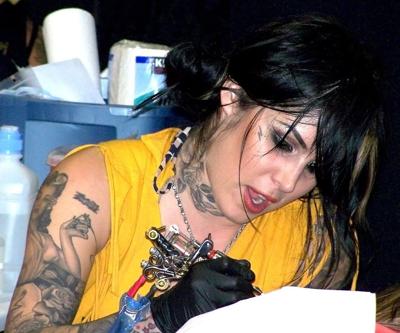


Celebrity tattoo artist Kat Von D
SAN FRANCISCO — A federal appeals court could be poised to rewrite the rules governing copyright infringement in California and other western states, as the court has agreed to take another look at a jury verdict that had let famed celebrity tattoo artist Kat Von D escape a lawsuit from a photographer who accused her of ripping off his famous photo of jazz trumpeter Miles Davis without permission.
On June 9, the full U.S. Ninth Circuit Court of Appeals agreed to earlier ruling from a three-judge panel that had upheld the verdict in favor of Von D.
The short order from the Ninth Circuit did not explain why the full court had decided to assign a so-called en banc panel of 11 judges.
However, the decision may signal that a majority of Ninth Circuit judges intend to set new guidelines, narrowing the ability of juries to use subjective reasoning to decide if one work infringes someone else's original art or other copyrighted piece.
The Ninth Circuit's order grants the petition for rehearing from photographer Jeffrey B. Sedlik.
Sedlik has been in court against Kat Von D, whose real name is Katherine Von Drachenberg, since 2021.
In his lawsuit filed in Los Angeles federal court, Sedlik accused Von D of essentially copying a photo he captured of Miles Davis and turning it into a tattoo without a license and release from Sedlik.
According to court documents, Sedlik, a professional photographer, created an iconic photograph of Miles Davis, capturing him, not with a trumpet in his hands, but rather placing a finger over his mouth, as if he is "making a 'Shh!' gesture."
Sedlik then "adjusted Davis's fingers so that the 'Shh!' symbol would represent a series of musical notes."
Sedlik also reportedly "adjusted Davis's hair ... wardrobe and jewelry," positioned him, and "made several decisions regarding lighting, camera positioning, and lens and shutter settings to ... achieve his desired result."
Sedlik copyrighted the work in 1994.
According to court documents, Sedlik protects his copyrighted work and requires a license to be purchased by anyone seeking to reproduce the work.
However, according to court documents, Von D publicly created a tattoo for a friend, identified as Blake Farmer, that Sedlik said reproduced his photo of Miles Davis on Farmer's arm and shoulder without license.
According to court documents, Farmer selected the photo and Von D then reportedly took the next steps in completing the tattoo.
She did not charge for her work, but did record the progress in posts online.
While Sedlik accused Von D of copyright infringement, a jury sided with the tattoo artist, finding the tattoo was "not substantially similar" enough to Sedlik's photo to allow him to force Von D to pay.
On appeal, a three-judge panel at the Ninth Circuit upheld the jury's verdict, but said they did so with misgivings. Those misgivings were based on what they called a "flawed" legal test set by the Ninth Circuit to determine copyright infringement.
In petitioning for a rehearing, Sedlik zoomed in on those concerns, asserting the Ninth Circuit should take the opportunity to reset the rules on the so-called "extrinsic-intrinsic" test.
The test is a two-step process to evaluate if an alleged offending work is "substantially similar" to a copyrighted original. On one hand, the court uses objective "extrinsic" factors to compare the works.
But the court then allows jurors to use more subjective "intrinsic" reasoning to decide if an observer would also believe the work offends copyright.
In this case, the jurors relied on the intrinsic factors to release Von D from Sedlik's claim.
However, in the Ninth Circuit's first take on the matter in January 2026, at least two of the three judges on the panel said they believed the court needed to revisit the test, and consider discarding the intrinsic elements altogether.
"This test and outcome distort copyright law," wrote Judge Kim McLane Wardlaw, in a special concurring opinion, joined by Judge Anthony D. Johnstone.
"... To be sure, a jury’s observation that two works have a similar 'concept and feel' may 'be important evidence' of infringement. But the jury’s impression that no such similarity exists — as occurred here — does not necessarily mean there was no infringement, as there can be 'theft without an immediate and spontaneous detection by the ordinary observer.'
"This is particularly true where, as here, the works exist in different media: a photograph and a tattoo. An ordinary observer, untrained in both media, 'may fail to note similarities that, if analyzed and dissected, would be only too apparent.'
"Or, worse, an ordinary observer may find, in practice, that works in different media almost never have the same 'total concept and feel.' Thus, the intrinsic test leaves the artist’s work vulnerable to 'clever thieves,'” Wardlaw wrote.
Wardlaw and Johnstone agreed that the court should "discard the intrinsic test and replace it with a legal rule that offers more consistent and even-handed protection to copyrighted works."


