
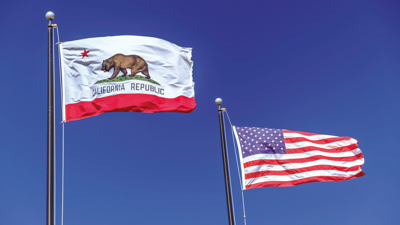


The California state flag flies alongside the U.S. flag.
LOS ANGELES — The federal government can sue the state of California to block the state from enforcing its rules banning the sale of eggs from chickens that were raised in cages, a federal judge has ruled, because the federal lawyers have done enough to show California is unconstitutionally attempting to use its state law to interfere with the ability of the federal government to regulate the nation's egg supply.
Ultimately, however, the judge said the "unprecedented" question will be answered on appeal.
On Oct. 2, U.S. District Judge Mark Scarsi sided with the administration of President Donald Trump and rejected California's latest attempt to dismiss the federal case.
The Justice Department has been in court against California since 2025, accusing the state of trampling federal authority and the rights of Americans living in other states by attempting to use a combination of state law and California's population and market size to essentially seize control over the production of eggs throughout the country.
The dispute is one of the latest flashpoints over what critics, and particularly Republicans outside California, have identified as a growing propensity by California Democrats to use California's position to bypass Congress and set national policy.
Among other conflicts, the Trump administration, other U.S. states and business groups have notably pushed back against California's efforts to take advantage of a longstanding special federal waiver, which gives California the authority to establish its own air pollution standards, to instead attempt to regulate the kinds of cars Americans can purchase and fuels they can use, everywhere.
While California rules ostensibly would apply only to California, the Golden State could also use its massive population and economic heft to force vehicle makers and others to bend to its desires, or risk losing access to the largest U.S. state market.
But in addition to energy and transportation policy, California in recent years has also attempted to extend its policy preferences over agriculture, as well, and meat and egg production, specifically.
In 2019, California enacted so-called Proposition 12, which set animal welfare standards over the production of chicken eggs, pork and veal.
Prop 12 was challenged most forcefully by America's pork producers, who asserted the law would unconstitutionally extend California's control over much of the U.S. meat supply, no matter where the meat is raised.
But in a complex series of opinions, the U.S. Supreme Court in 2023 narrowly ruled 5-4 mostly in California's favor, with the end result being California could control the conditions under which the meat and eggs potentially sold in California are raised.
However, in 2025, after Trump began serving his second term in office and with the U.S. grappling with a surge in the price of eggs, the Trump administration challenged California's rules mandating cage-free eggs, specifically.
In that challenge, the administration said California's rules conflict with federal law governing the nation's egg supply. So, the administration argued, under the constitutional principle of federal supremacy, California's rules must give way to federal way and be struck down.
California initially prevailed in the case, as Judge Scarsi in the spring of 2026 agreed to dismiss the legal action, finding the federal government failed to show how the seeming conflict harmed the federal government.
The Justice Department amended the complaint, however, now including additional claims.
And the judge said those additions to the complaint now correct those shortcomings, saying the new complaint "raises a plausible inference that the (California egg) Sales Ban undermines" federal regulations developed by the U.S. Department of Agriculture under the law known as the Egg Products Inspection Act (EPIA) to ensure the U.S. maintains its egg supply.
However, the judge acknowledged the question is not only a legal close call, but also something no court has ever answered directly under these circumstances.
So, the judge put his ruling on hold, and immediately agreed to allow the legal question to advance to the U.S. Ninth Circuit Court of Appeals to handle.
From there, given the implications to the nation's food supply and to the question of determining the proper boundaries between state and federal power, the matter could also ultimately land at the U.S. Supreme Court.
It is not known when the Ninth Circuit may take up the case.
