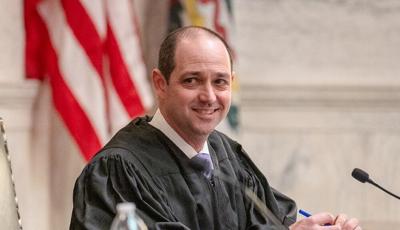


West Virginia Supreme Court Justice Gerald Titus
CHARLESTON – Gerald Titus sees himself as a problem solver. That’s why he wants to continue to serve as a West Virginia Supreme Court justice.
“I come from a problem-solving small-town background,” Titus, who grew up in Spencer, told The West Virginia Record. “As a federal prosecutor and as a litigator, I often was given the difficult hard-to-solve cases, whether it was a procedural obstacle with it or just needed the attention of someone who wasn’t afraid to take on something.
“I took that a challenge. I felt I could pick up anything.”
Titus, who was appointed to the court last year by Gov. Patrick Morrisey, is seeking election to the bench in the May 12 primary for one of two seats on the court in the nonpartisan race. The winner will serve the remainder of late Justice Tim Armstead’s term until 2032.
Titus’ opponents for the seat are Eastern Panhandle Circuit Judge Laura Faircloth, Raleigh Circuit Judge Todd Kirby, retired Raleigh Circuit Judge H.L. “Kirk” Kirkpatrick and Wheeling attorney Martin Sheehan.
Titus says his diverse legal experience and judicial experience make him the best candidate for the job.
“I’m the only sitting Supreme Court Justice in the race,” Titus said. “The job entails more than the aspect of presiding over cases in court and deciding cases. There’s also a significant administrative component helping our unified court system function in all 55 counties. We have duties that include budget, human resources, technology and strategic planning.
“As a person who has a been the business owner of a multistate law firm who brings a commitment to fiscal responsibility, that gives me an advantage.”
Titus said he also understand the Supreme Court’s role.
“It’s important to be mindful of the judiciary’s role in our form of government and the need to avoid legislating form the bench,” he said. “Staying in the court’s constitutional lane, so to speak.
“It’s a matter of having the right attitude and approach. I’m someone who believes in being mindful every day of setting myself aside and following the law. Every party deserves fairness and impartiality. I have the temperament to do this job fairly and impartially and to treat all parties with respect.”
Titus said the role of the state Supreme Court is to apply the law as written and faithfully adhere to the Constitution.
“The Supreme Court represents finality, so it’s our responsibility the proper result is achieved under law,” he said. “It’s not only important to the parties, but there is a ripple effect on the entire state and everyone in it.
“We also have the administrative responsibility budget of $177 million and 1,600 employees in all 55 counties with about 85 percent of that budget being personnel costs. So, there’s a huge component of our work that is analogous to running a business. We have to ensure return on investment, and the return is measured in justice. It’s not about profit. It’s about reaching the correct result under the law and doing it as efficiently as possible.”
Titus said being a collaborative person also helps him on the Supreme Court.
“There are five of us, and we reach our decisions through open and honest debate with one another,” he said. “You have to be able to communicate and listen. And I have all of those qualities.”
Titus said he has recused himself from cases several times in his time on the court when his former law firm was representing one of the parties.
On a recent campaign mailer and on social media, Titus was endorsed by state Attorney General J.B. McCuskey, who is a longtime friend. State ethics rules say that endorsement isn’t illegal or unethical. Previous situations (such as Justice Warren McGraw being allowed to hear involving brother Darrell McGraw’s AG’s office) and ethics opinions support that.
Titus said McCuskey’s endorsement and friendship wouldn’t cloud his opinion when handling a case that involves the AG’s office.
“My approach is that the judiciary must be independent from the other branches of government,” Titus said. “Endorsements are nice and appreciated, but I absolutely maintain my own judicial independence. I sit myself aside and follow the law. In every case, there’s a winner or loser.”
Titus thinks the Supreme Court sets the tone for fairness and the rule of law in the state.
“As for me, as a justice, I feel a responsibility to ensure the public has confidence in the judiciary, in part, because in recent memory, there have been times the court fell short of that,” Titus said. “We are past that, but it’s mindful to know people should know they get a fair shot when they bring their case into court. And I think we’re doing that very well.
“Still, I think we can continue to show leadership in the areas of working to ensure that the child abuse and neglect docket in all of the courts in West Virginia moves faster. And to explore opportunities for making it easier to attract lawyers to rural areas of West Virginia because those two problems compound one another.
“In many areas, we don’t have enough lawyers to cover the abuse and neglect docket. But also, that docket has become such a large part of the court’s business. I think it makes it more difficult to attract rural lawyers.”
It’s his first time on a ballot, and Titus said running a statewide campaign has changed his perspective on the state in an unexpected way.
“I’m originally from Roane County in the central part of our state,” he said. “I grew up very much with an identity of one unified West Virginia. And that’s just how I’ve always seen it.
“But traveling to the different unique regions of our state, you appreciate that there are extremely distinct cultural and economic identities in different parts of our state. So it’s a challenge for our leaders to get all of those parts of the state working together for the common good of our state.
“We have a unique history and a unique geography. This is our state. We all have to work together. I have to be mindful. For a small-town boy from West Virginia, it’s been an education.”
Titus said the campaign has been a grind.
“Right now, it’s day shift and night shift,” he said. “We have completed all of our oral arguments for the term, and we’re working on opinions. As I’m traveling around the state, I’m sitting in the passenger seat editing opinions, sending emails to my law clerks and working to get opinions into shape before the end of the term.
“And there are a lot of late nights at the kitchen table doing the same thing. You have to learn how to maximize your time and get the most out of the time you need to do your duties and the time you need to run a statewide campaign. It is a challenge. You have to be very good at logistics. Have to be willing to work hard.”
But he said some parts of the campaign trail are fun.
“Meeting people and getting to tour places … that’s easy,” Titus said. “I learned very early on the importance of just being yourself. You don’t have to be perfect. It happened in the first speech actually. I forgot to say something.
“What you learn is that people will understand what your intentions are, and at the end of the day, I think that’s what matters more than what you said the exact perfect sentence. You’re better off being a good listener and being yourself, meet as many people as you can, listen and internalize what’s important to them.”
Titus received his undergrad and law degrees from Washington & Lee, where he also played basketball. He practiced law in Charleston for 22 years, first at a small firm before he became a federal prosecutor. Then, he worked at Spilman Thomas Battle as a general litigator. He is married, and he and wife Meredith have three children – Nora (10), Brandt (8) and Davis (4).
“It’s been interesting for them,” Titus said of the campaign. “My daughter has introduced me at events, which has been special. The other day, my son Brandt asked me, ‘Dad, does a famous person like Taylor Swift … does their vote count more than a regular person?’
“To do what I’m doing has been hard on them. It is disruptive to family life, but everybody has to chip in and sacrifice some. I’m grateful for that.”
Titus said being on the Supreme Court has been the honor of his career, and he hopes to continue that service.
“I don’t just want to be a Supreme Court Justice,” he said. “I’m already doing that. That’s not what this is about. I want to serve, and my campaign is about fighting as hard as I can to fight for the opportunity to serve because it’s my greatest opportunity to make a positive impact on the state for my children, everyone else’s children and their grandchildren. That’s why I’m doing this.”