
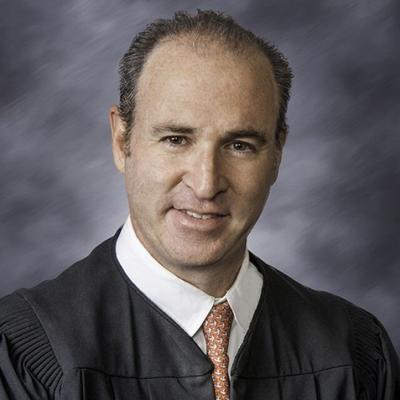


California Supreme Court Justice Joshua Groban
SACRAMENTO — The California Supreme Court has narrowed the ability of prosecutors, county attorneys and other lawyers to secure "blanket" recusals from judges they may not wish to hear their cases.
In a unanimous ruling, the state high court refined the state’s court rules to clarify that lawyers' attempt to challenge the ability of a judge to hear a case now can be subject to scrutiny to determine if it is being made in "good faith."
The underlying dispute involves a party identified only as J.O., who is subject to a conservatorship, specifically the San Joaquin County Public Conservator. In August 2024, San Joaquin County Counsel filed a motion to remove Judge Erin Guy Castillo from J.O.’s case, a motion she quickly granted. J.O. then filed an opposition to all the county counsel’s motions regarding Judge Guy Castillo, alleging they were improper "blanket" filings that followed the judge's decision to admonish a deputy county lawyer earlier that year.
J.O. said the move was retaliatory and resulted in Judge Castillo being reassigned from conservatorship and mental health cases to small claims, traffic and misdemeanor matters. By the time Superior Court Judge Kristine Eagle took over Castillo’s assignment, county counsel had already filed 325 reassignment motions, according to J.O.
In September 2024 Judge Eagle denied J.O.’s opposition motion, but did say “if the public defendant seeks to advocate for a change in the law … the court thinks that’s an entirely reasonable route to take.”
J.O. sought a mandate from the California Third District Appellate Court, asking it to revisit the reasoning of a 1977 California Supreme Court ruling, Solberg v. Superior Court, and its stance on the risk so-called blanket challenges might pose to judicial independence. That panel refused the request, leading J.O. to the Supreme Court.
Justice Joshua Groban wrote the court’s opinion, filed May 28. Justice Tracie Brown, of the First District California Appellate Court, sat on the court by designation.
Groban said the relevant section of state law stipulates “that if any party or attorney makes a timely motion to disqualify a judge, supported by an affidavit or oral statement under oath that the judge is prejudiced against such party or attorney or the interest thereof, ‘the judge must recuse himself without further proof and the case must be reassigned to another judge.’ ”
He traced the history of legislative action and judicial decisions addressing jurist disqualification back nearly a century, including distinctions between criminal proceedings and civil litigation as well as incidents of lower courts calling for a new look at Solberg.
San Joaquin County Counsel argued the top court “should not revisit Solberg because doing so risks undermining stability in judicial disqualification law, interferes with legislative prerogatives, and fails to address the root causes of modern judicial challenges.” While Groban acknowledged “concerns about decisional consistency,” he also noted that even Solberg was decided based on the prior two decades of experience under the relevant state law and contemplated future adjustments to manage “competing interests of bench, bar and public.”
The court then explained why Solberg “is no longer tenable” with respect to the conclusion that a blanket abuse of the disqualification law didn’t substantially hamper the separation of the three traditional government powers: legislative, executive and judiciary.
“Superior court case filings have significantly increased,” Groban wrote. “For instance, in 1977, there were 54,653 felony criminal cases filed, whereas in the 2023 to 2024 fiscal year, there were 179,821 criminal felony filings. In the midst of growing operational demands, the judicial branch has also been hampered by budget cutbacks. Additionally, the superior courts have been impacted by judge shortages.”
If a party engages “in the bad faith practice of removing a judge from all or a substantial portion of cases, or all or a substantial portion of cases of a particular type without a legitimate belief in the judge’s prejudice toward the litigant,” Groban wrote, courts must then redistribute work across an already limited judicial roster, hampering efficiency and independence across all cases.
Groban further noted shifts in the approach to certain types of cases “necessitated greater judicial specialization,” making disruption easier. This is especially true with regards to family or juvenile dependency courts and others known as problem solving or collaborative justice courts focusing on things like domestic violence, homelessness, driving under the influence and mental health.
Using blanket challenges to effectively “remove a dedicated judge from a specialized calendar,” Groban said, is a kind of weaponization that defeats the assignment authority of a presiding judge.
“Superior courts have been faced with both voter and legislative enactments that have generated entirely new proceedings, increased caseloads and case complexity, and have significantly altered the substantive law,” Groban wrote. “These new laws require specialized knowledge for their implementation. Courts will not be able to optimize that specialized knowledge and experience if judges can be unfairly removed from all or a substantial portion of cases of a particular type.”
Groban said J.O.’s allegations about what happened to Judge Guy Castillo align with those concerns, but also noted some smaller counties only have two judges, increasing the risk of interference from blanket challenges. Regarding challenges against Guy Castillo, Groban continued, there is “a clear and unacceptable risk of interfering with court operations.”
The California Judges Association filed a support brief claiming “pervasive” abuses of the disqualification law and suggested a “constitutional crisis” that already has the attention of the Committee on Revision of the Penal Code. Only five other states have policies similar to California’s, the court observed, while also highlighting many suggestions of increased abuse of the law.
Groban said the court now agrees with Solberg’s minority opinion, written by Justice Mathew Tolbriner, and its “ultimate conclusion that we are not powerless to act in the face of such an assault on the judiciary. To the contrary, our constitutional structure requires us to act.”
However, the court said it also is important to consider what exactly gives rise to a separation of powers concern: Is any blanket challenge problematic or does the moving party have to represent the executive branch?
J.O. and others argued “only bad faith blanket challenges by executive agencies can unconstitutionally encroach on judicial functions,” Groban wrote, because any other agency is acting “on behalf of individuals, not a branch of government, and thus they cannot be the source of an inter-branch conflict proscribed by the separation of powers doctrine.”
But the California Judges Association said “the legislative scheme itself” is the problem. And the California District Attorneys Association noted public defenders have nearly as much power as government lawyers since about 80% of all felony defendants use a public defender. The court agreed with those positions, noting the law prohibits “inquiry into the veracity of timely and properly presented affidavits or oral statements under oath.”
That means in addition to the power of county attorneys or public defenders, private lawyers and firms could be disruptive, especially in smaller counties or by focusing on specialized legal matters.
“And in any event, the separation of powers problem at issue here arises whenever a litigant engages in bad faith blanket challenges to avoid appearing before a judge, even if other judges remain available to adjudicate cases involving that litigant. The effect of such blanket challenges may differ in degree, but not in kind.”
The court concluded by outlining procedures for implementing its new position. It stressed that blanket challenges can arise from good faith and be allowed to stick because they “are in step with the courts’ duty to ensure the effective and efficient administration of justice.” Groban likened the landscape to the presumption prosecutors can “exercise peremptory challenges to prospective jurors in a constitutional manner” and said anyone opposing a disqualification motion has to “demonstrate a prima facia case” the moving party is acting in bad faith.
When the party meets that bar, Groban said, a different judge shall conduct a hearing as soon as possible, at which point the person asking for a new judge has to adequately explain their challenge. Then a trial judge can decide whether the original judge keeps the case in question or if it’s reassigned.
The court remanded J.O.’s case to the appellate court to determine if further proceedings are necessary.
J.O. was represented by public defenders.