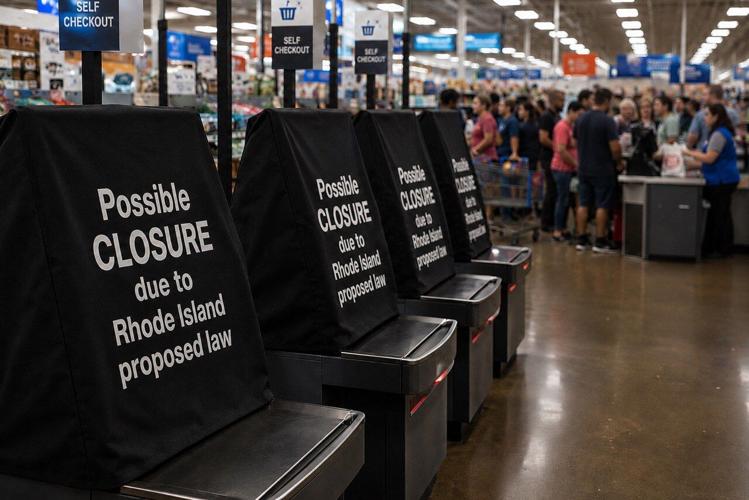


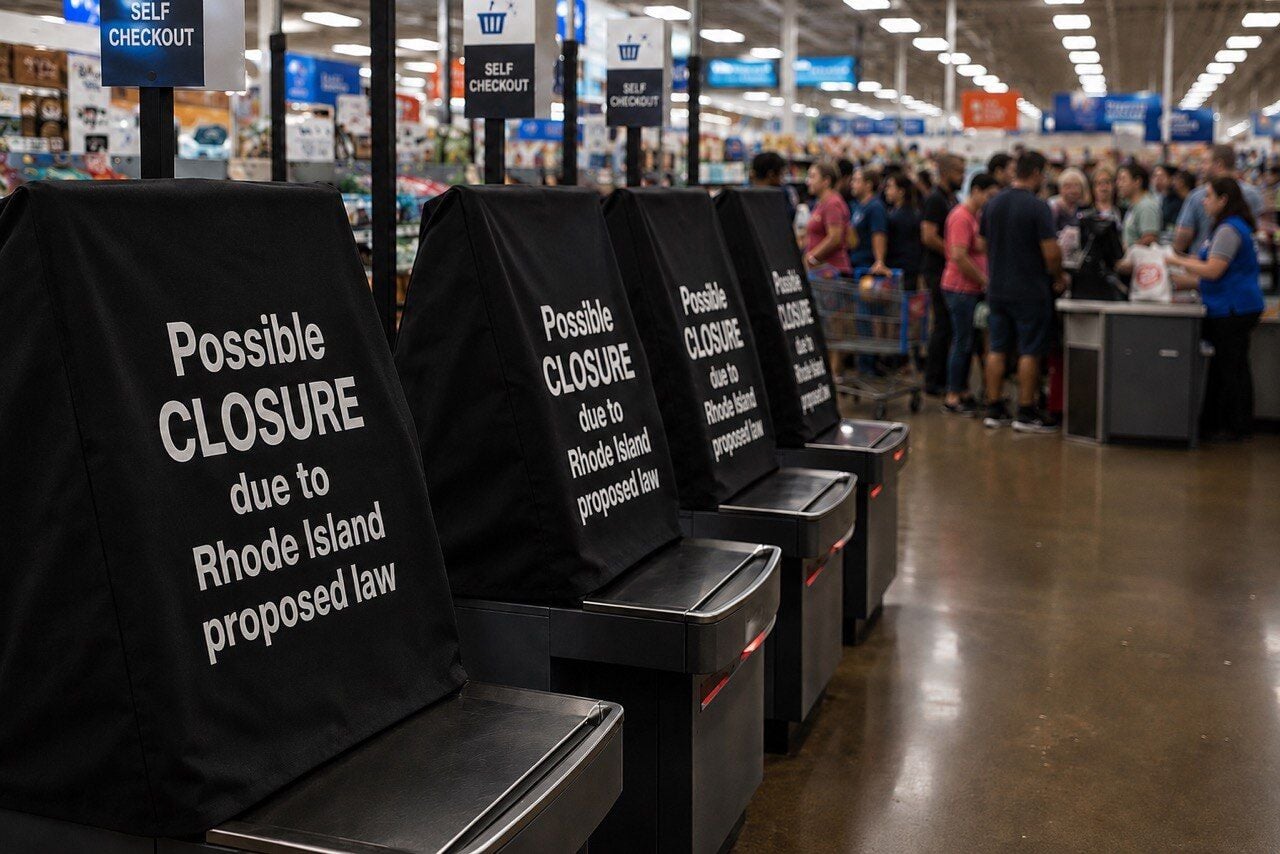
This AI illustration shows what could happen if Senate Bill 2342 passes the Rhode Island General Assembly.
PROVIDENCE, R.I. – A bill that would add restrictions to self-checkout lanes has passed the Rhode Island Senate.
Senate Bill 2342 would require grocery stores to have one staffed checkout for every three self-checkout lanes. The pro-labor bill passed the Senate May 21 and is headed to the House of Representatives.
According to the bill, “grocery store” means a business that earns the majority of its gross income from the retail sale of groceries. That means Walmart and Target also are included in the restrictions.
Noncompliance would be handled with fines, state enforcement by the state Attorney General and anti‑retaliation protections for employees and consumers.
The bill also says at least one manual checkout station must comply with the Americans with Disabilities Act (ADA), and any employee monitoring self‑service checkout stations must be relieved of all other duties, including running a manual checkout, while monitoring the self‑checkout.
The consumer protection unit of the Department of Attorney General has primary authority to enforce the restrictions and to write implementing regulations.
This isn’t the first time such a bill has been introduced in the Rhode Island General Assembly.
The 2025 version of the bill required at least one staffed checkout lane for every two self-checkout stations and capped stores to six self-checkouts. The 2023 version of the bill capped self-checkouts at eight with a 1-to-1 staffing requirement. So, the ratio has loosened over successive sessions.
If the current bill is passed, Rhode Island would be the only state in the country to impose such restrictions.

Lawson
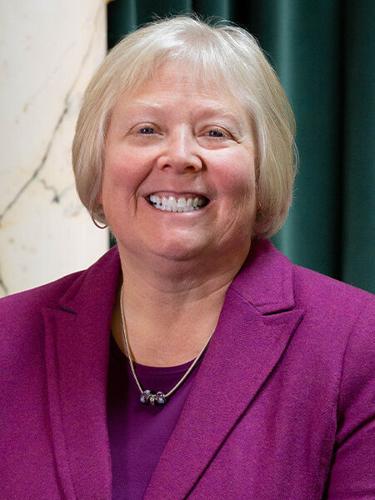
Senate President Valarie Lawson (D-East Providence) is one of the sponsors of the bill. She says it is meant to help cashiers as well as customers who might struggle with checking out their groceries.
The president and CEO of the Northern Rhode Island Chamber of Commerce says businesses must continually adapt, but this bill doesn’t help businesses or consumers.
“One way for the retail industry to adapt is to provide customers with an opportunity to self check their purchases,” Monika P. Zuluaga wrote about the bill. “Many customers actually prefer this option. S.2342 discourages the use of such technology, thus placing a business in a difficult situation of being unable to serve the majority of its customers.
“Additionally, and perhaps more disturbingly, the state proposes to enter a particular business and mandate day-to-day operations that are not related to health and safety. From the business perspective, this is state overreach and creates an environment companies will not want to enter.”
Tracy Anthony of Clements Marketplace expressed similar concerns.
“As a small, independent business, we have always placed our emphasis on quality and service because we are not able to get the pricing that the large companies can,” Anthony wrote. “We added Fast Lanes (self checkouts) in an effort to service our customers well.
“Prior to implementation, I had customers asking why we did not have them for some time. It was widely conveyed that self-checkout added an increased level of convenience and efficiency as a way to get them in-and-out quickly. They effectively reduce the likelihood of customers being slowed down by large orders processing ahead them. We have always listened to our customers and tried to satisfy their needs.”
Since installing the Fast Lanes, Anthony said Clements has not decreased checkout staff and has added to its service desk team to help manage the Fast Lanes and always have checkouts with manned cashiers.
“What this bill will do to our industry, and our stores in particular, is create an atmosphere of inadequate service levels often,” Anthony wrote. “We get many more sick calls now and, although we have more staff on our rosters, are often unable to get coverage for the shifts.
“This law will create chaos in our checkout areas because we will not be able to efficiently service customers. They will be left to wait because Fast Lanes will have to be shut down to follow the law. …
“Our industry, as a whole, has always cared about service. One segment of retail should not be singled out by a law. If there is a real concern with self-checkouts then a law should pertain to all self-checkouts and not one group.”
Scott Bromberg, executive director of the Rhode Island Food Dealers Association, agrees.
“This proposal is especially egregious because it specifically targets only grocery stores,” Bromberg wrote. “Big box retailers, along with hardware stores, pharmacies, dollar stores, fast food chains and more utilize self-checkout to allow them to deploy their staff where needed most.
“The issues surrounding self-checkout are not unique to grocery stores and this bill implies that self-checkout concerns only happen at grocery retailers. This puts Rhode Island grocers at a significant competitive disadvantage.”
Bromberg said many customers prefer the convenience provided by self-checkout stations that allow them to save time.
“This has been researched and studied by our membership,” he wrote. “It should remain the choice of the customer to use self-checkout. According to a study by Progressive Grocer, 44% of U.S. grocery shoppers prefer to pay via self-checkout, and 77% believe it is faster.
“This should remain a consumer’s choice to utilize self-checkout. There are always traditional register lanes available.”
The only self-checkout restriction that has passed anywhere in the country is in a municipality in California. Although the State of California is considering a bill, it is less restrictive and burdensome than the Rhode Island measure. And a nearly identical proposal was considered by the Massachusetts Legislature last year but did not pass.
For multiple violations by the same grocery store (at one or multiple locations), fines per day are set at the wages for one eight‑hour shift based on the highest hourly wage for retail clerks, capped at $1,000 per day. If a store still fails to comply 30 days after receiving notice of a violation, that non‑compliance becomes an “unlawful act” enforceable under the state’s Deceptive Trade Practices Act provisions.
The bill says any employee may file a complaint with the state Department of Labor and Training alleging a violation. An employee who alleges retaliation for filing a complaint can bring a cause of action in superior court.
Consumers may also file complaints with the Department of Labor and Training if they believe the law is being violated. Retaliation against a consumer for filing such a complaint is treated as an unlawful act under the same deceptive practices statutes.

Cotter
Lawson is a longtime teacher and union leader who now serves as president of the National Education Association Rhode Island, one of the state’s most influential unions. Rep. Megan Cotter (D-Exeter) is the primary sponsor of the House version of the legislation. She said the bill is about both cashier and customer protection.
According to campaign finance reports, both Lawson and Cotter have received donations in the last few years from several unions. Lawson has received at least $3,000 in donations from NEARI herself since 2024.
In addition, she has received several donations from unions in 2026. Those include $1,000 from the Amalgamated Transit Union, $100 from the Associated Builders & Contractors RI, $1,000 from Construction Industries of RI, $1,000 from Coventry Professional Firefighters PAC, $1,000 from Cranston Firefighters Local 1363, $1,000 from East Greenwich FFS Committee, $1,000 from East Providence Firefighters, $200 from Fire Chiefs PAC, $1,000 from IBEW Local 2323 PAC, $2,000 from IBEW Local 99 PAC, $500 from Iron Workers Local 37, $300 from Johnston Association Firefighters, $300 from NEA RI Retired PAC, $500 from Pawtucket Firefighters Local 1261, $700 from RI Council 94 AFSCME AFL-CIO PAC, $500 from Plumbers & Pipefitters Local 51 PAC, $1,000 from Professional Women & Building PAC, $1,000 from Providence Firefighters Local 799, $200 from Providence RI Central Federated Council, $200 from Providence Teachers COPE, $1,000 from RI AFL-CIO PAC, $500 from RI Federation of Teachers COPE PAC, $1,000 from RI Hospitality PAC, $1,000 from RI Laborers’ PAC, $500 from RI Laborers’ State Employees PAC, $1,000 from RI State Association of Firefighters, $200 from Sheet Metal Workers PAC, $200 from Teachers Association of Newport PAC, $500 from Teamsters LU251 Drive PAC, $500 from United Food & Commercial Workers Union, $500 from United Nurses & Allied Professionals, $200 from Utility Workers Union of America Local, $2,000 from Warwick Firefighters PAC, $400 from Warwick Teachers Union 915 and $200 from West Warwick Firefighters Local 1104.
Since 2024, Cotter has received donations from various unions, including $450 from NEARI, $125 from the International Union of Painters & Allied Trades, $100 from IBEW Local 99 PAC, $100 from Iron Workers Local 37, $100 from RI AFL-CIO PAC, $100 from RI Brotherhood of Correctional Officers, $250 from RI Federation of Teachers COPE PAC, $100 from RI NAGE/IBPO PAC, $200 from Teamsters LU251 Drive PAC, $500 from United Food & Commercial Workers Union, $125 from Cranston Firefighters Local 1363 COPE PAC, $50 from Cranston Teachers’ Alliance, $150 from RI Council 94 AFSCME AFL-CIO PAC, $125 from Professional Fire Fighters of Rhode Island, $100 from Providence Teachers COPE and $200 from RI Laborer’s Political League.